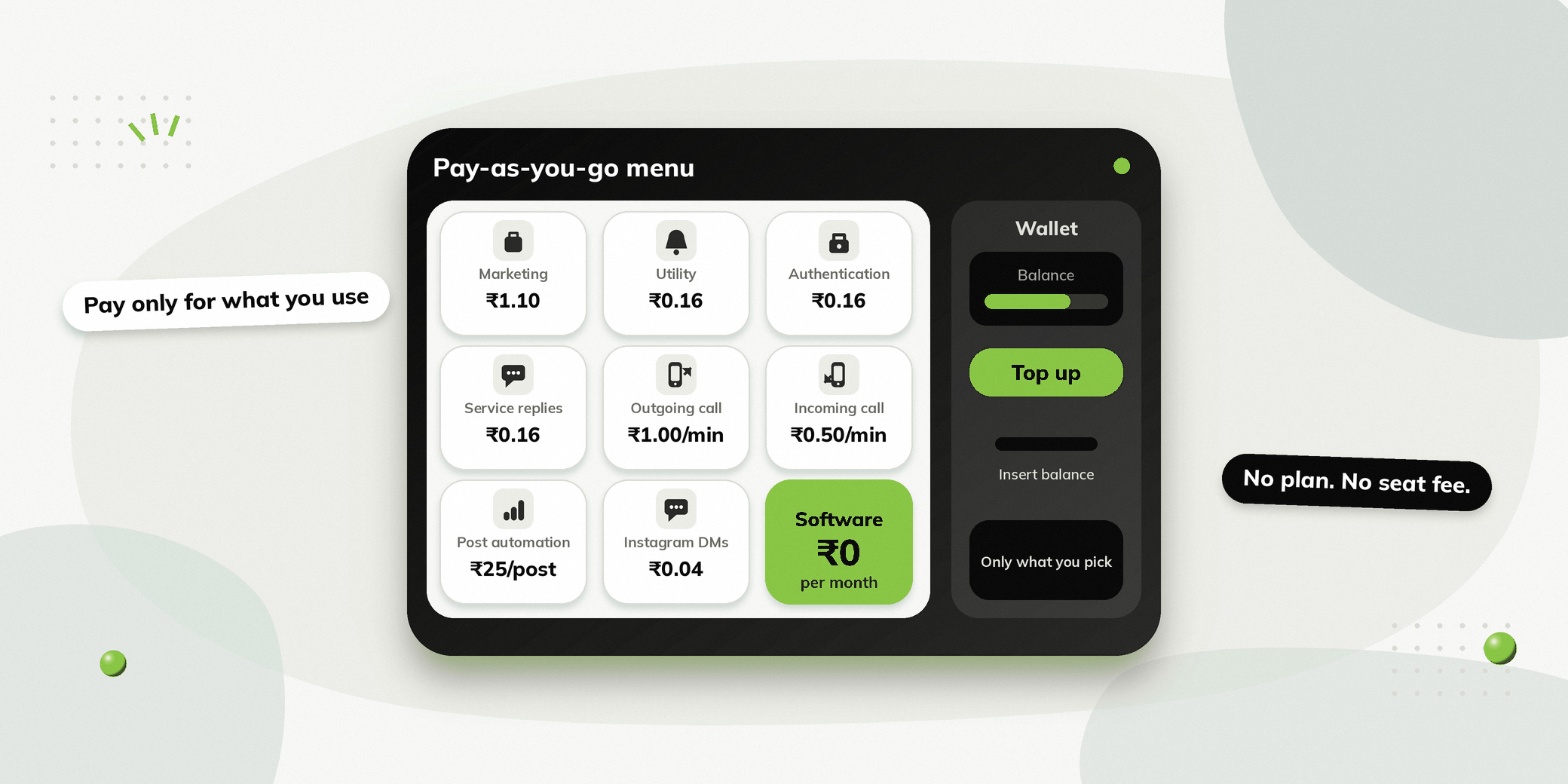
Most WhatsApp Business API providers charge Indian SMEs a fixed monthly fee, whether they send 50 messages that month or 50,000. Vezly runs on a pay-as-you-go WhatsApp API model.
The software itself costs ₹0 per month. You add money to a wallet, and that balance is consumed only when you actually send a message, place a call, or automate a post, split across communication, calling, and Instagram/Facebook activity.
Key Takeaways
- Vezly’s software is ₹0 per month: every feature, every channel, unlimited team members, no plan or seat fee.
- You’re billed per message, per minute, or per post, not a flat monthly rate.
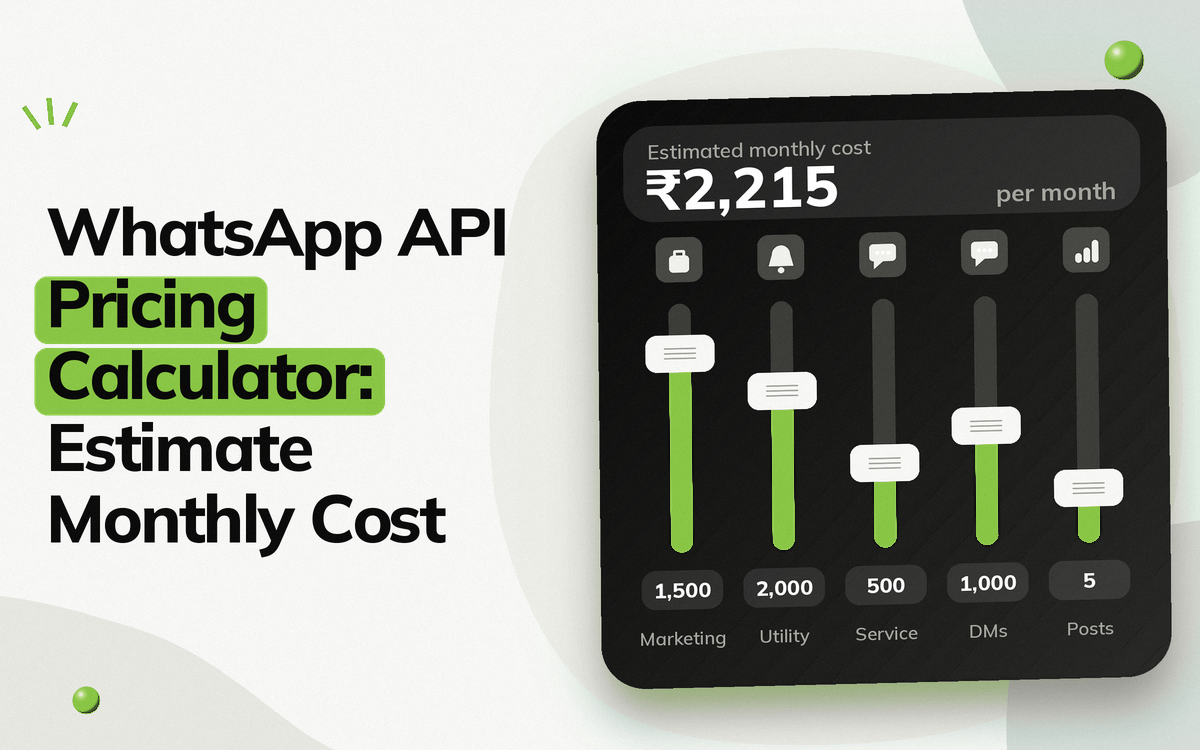
- Marketing messages (₹0.99) cost more than Utility, Authentication, or Service replies (₹0.15 each).
- Calling is billed separately: ₹1.00/minute outgoing, ₹0.50/minute incoming.
- Instagram and Facebook automation is priced per post (₹25) and per DM (₹0.04).
Why Subscription-Based WhatsApp API Pricing Is a Problem for SMEs
Most WhatsApp Business API providers in India sell access in tiers: a base plan that covers a set number of conversations or messages, plus overage charges once you cross that limit. On paper this looks simple. In practice it creates two recurring problems for small and mid-sized businesses.
The first is paying for capacity you don’t use. A coaching institute might get 1,500 enquiries during an admissions push in June and 300 in a quieter month. A fixed plan sized for June sits mostly idle the rest of the year, and a plan sized for the quiet months triggers overage fees every time a campaign works.
The second is the psychology of a sunk monthly cost. Once a business is paying ₹5,000 to ₹20,000 a month regardless of usage, the platform becomes another fixed overhead to justify, not a tool tied to actual business results. For a founder or marketing head watching costs closely, that’s an uncomfortable position to be in, especially if enquiry volume is unpredictable.
This is why “pay as you go WhatsApp API” has become a search term in its own right: business owners are actively looking for pricing that doesn’t lock them into a fixed monthly number. Here is how usage-based pricing compares in India.
What “Pay-As-You-Go” Actually Means for a WhatsApp API
A pay-as-you-go WhatsApp API model bills only for what a business consumes, rather than for the right to use the platform at all. There’s no base fee for keeping the account active, no tier to upgrade or downgrade as volume changes, and no unused allowance expiring at the end of the month.
For an SME, this changes the relationship between cost and usage in a direct way: a quiet month costs less, a busy month costs more, and the bill always tracks what the business actually did, not what it signed up for.
How Vezly’s Wallet Model Works
Vezly replaces subscription tiers with a prepaid wallet. Where other providers sell a subscription, Vezly charges ₹0 per month for the software. A business adds funds to the wallet, and that balance is drawn down as the account is used, split across three areas.
Three Billable Categories, One Wallet
Communication. Messages sent or received through campaigns, live conversations, no-code chatbot flows, automated follow-ups, and notifications. Whether a message originates from a customer replying to a Meta ad, a broadcast campaign, or an automated reminder, it draws from this balance.
Calling. Charged by the minute, for businesses that move high-intent conversations from chat into a phone call, for example a real estate broker following up after a WhatsApp property enquiry.
Instagram & Facebook. Comment-to-DM automation and shared-inbox DMs across Instagram and Facebook, priced separately from WhatsApp communication, so you can manage WhatsApp, Instagram and Facebook from one dashboard.
Keeping these separate rather than combining them into one bundled number matters for a practical reason: a business that runs heavy WhatsApp campaigns but never uses calling isn’t paying for calling capacity it doesn’t need, and a business running Instagram comment automation can see exactly how much of its spend is going toward that specific feature.
Vezly’s Pay-As-You-Go Pricing Breakdown
Here’s what each category actually costs, rather than a fixed monthly number to guess at.
Communication
| Message type | What it covers | Price |
|---|---|---|
| Marketing | Offers, promotions, new arrivals, re-engagement, anything sent to win business | ₹0.99 per message |
| Utility | Order updates, appointment reminders, payment receipts, delivery alerts | ₹0.15 per message |
| Authentication | OTPs, account verification, login codes | ₹0.15 per message |
| Service replies | Free-form replies your team or chatbot sends inside the 24-hour window after a customer writes to you | ₹0.15 per message (Meta has charged for these since 1 October 2026) |
Calling
| Direction | What it covers | Price |
|---|---|---|
| Outgoing | Calls you place to a customer from inside a conversation | ₹1.00 per minute |
| Incoming | Calls a customer places to you through WhatsApp | ₹0.50 per minute |
Instagram & Facebook
A flat rate per post, and a fraction of a rupee per DM.
| Type | What it covers | Price |
|---|---|---|
| Post automation | Comment-to-DM and story reply automation on an Instagram or Facebook post, charged once per post regardless of comment volume | ₹25 per post |
| Direct messages | Instagram and Facebook DMs answered in your shared inbox, by your team or chatbot | ₹0.04 per message |
The platform
| Item | What everyone else calls a subscription | Price |
|---|---|---|
| Software | Every feature, every channel, unlimited team members. No plan, no seat fee, no add-ons | ₹0 per month |
The last row is the part worth sitting with: the software itself is free. There’s no plan to pick, no per-seat cost for adding team members, and no feature gated behind a higher tier. The only thing that costs money is the messages, calls, and posts a business actually sends or automates.
This also surfaces a nuance a flat monthly plan hides: Marketing messages (₹0.99) cost meaningfully more than Utility, Authentication, or Service replies (all ₹0.15). A business running heavy promotional broadcasts will see a different cost profile than one that mostly sends appointment reminders and OTPs, and can see that difference directly instead of it being absorbed into one bundled plan price.
What This Looks Like in Practice
Consider a dental clinic running Instagram ads that drive enquiries to WhatsApp, with WhatsApp automation for appointment booking handling the follow-up. On a subscription plan, the clinic would need to estimate monthly conversation volume in advance and pick a tier, then either pay for headroom it doesn’t use in slow months or hit overage charges during a promotional push.
On Vezly’s pricing, the clinic pays ₹0 for the software and only the per-message and per-post rates for what actually happens: appointment reminders at ₹0.15 each, a promotional broadcast before a seasonal offer at ₹0.99 per message, and ₹25 for automating comment replies on a single high-engagement Instagram post. A quiet week between campaigns costs very little. A week with an active promotion costs more, but only in proportion to the messages that week generated.
This also removes a specific piece of decision friction at signup: a business doesn’t need to forecast its enquiry volume accurately before it can start, because there’s no tier commitment to get wrong.
Pay-As-You-Go vs. Fixed Subscription: A Direct Comparison
Wondering which pricing model costs less? Here is a side-by-side view.
| Factor | Fixed subscription | Vezly’s wallet model |
|---|---|---|
| Monthly software cost | Fixed fee regardless of usage | ₹0 per month |
| Cost during a quiet month | Same as any other month | Lower, tracks reduced activity |
| Cost during a busy month | Overage charges likely | Higher, but proportional to activity |
| Forecasting needed at signup | Yes, to pick the right tier | No tier to choose |
| Pricing granularity | Usually one bundled number | Per message type, per minute, per post |
| Team seats | Often priced per seat | Unlimited team members included |
Getting Started with the Wallet
- Create a Vezly account and connect the relevant channels (WhatsApp, Instagram, Facebook).
- Add an initial balance to the wallet.
- Launch a first workflow, whether that’s a campaign, a chatbot flow, or a simple live-chat setup.
- Monitor spend against the pricing table above as conversations, campaigns, and calls happen.
- Top up the wallet as needed, with no separate plan tier to renegotiate.
The Bottom Line
A pay-as-you-go WhatsApp API removes the guesswork of picking a subscription tier and the frustration of paying for capacity that goes unused. Vezly’s model applies this directly: ₹0 per month for the software, with clear per-message, per-minute, and per-post rates for everything else. For SMEs whose enquiry volume shifts with campaigns and seasons, that’s a more direct match between what they pay and what their conversations are actually worth.
If your business already gets regular enquiries through WhatsApp, Instagram, or Facebook, the next step is comparing your current monthly subscription cost against what the same activity would actually cost per message here.
Why do Marketing messages cost more than Utility or Authentication messages?
Marketing messages (offers, promotions, re-engagement) are priced at ₹0.99 per message, while Utility, Authentication, and Service replies are priced at ₹0.15 per message, reflecting the different message categories.
What changed on 1 October 2026?
Service replies, the free-form replies sent inside the 24-hour window after a customer writes in, are now charged at ₹0.15 per message from that date.
Does this work for businesses with very low or very high enquiry volume?
It scales in both directions since there’s no minimum spend tied to a plan tier and no ceiling that forces an upgrade, though very low-volume businesses may find the per-message model less impactful than higher-volume enquiry-driven businesses.